What do you write in an engagement card?
What you write in an engagement card should congratulate them warmly on the engagement itself, then say you're looking forward to the wedding: short and genuine beats elaborate.
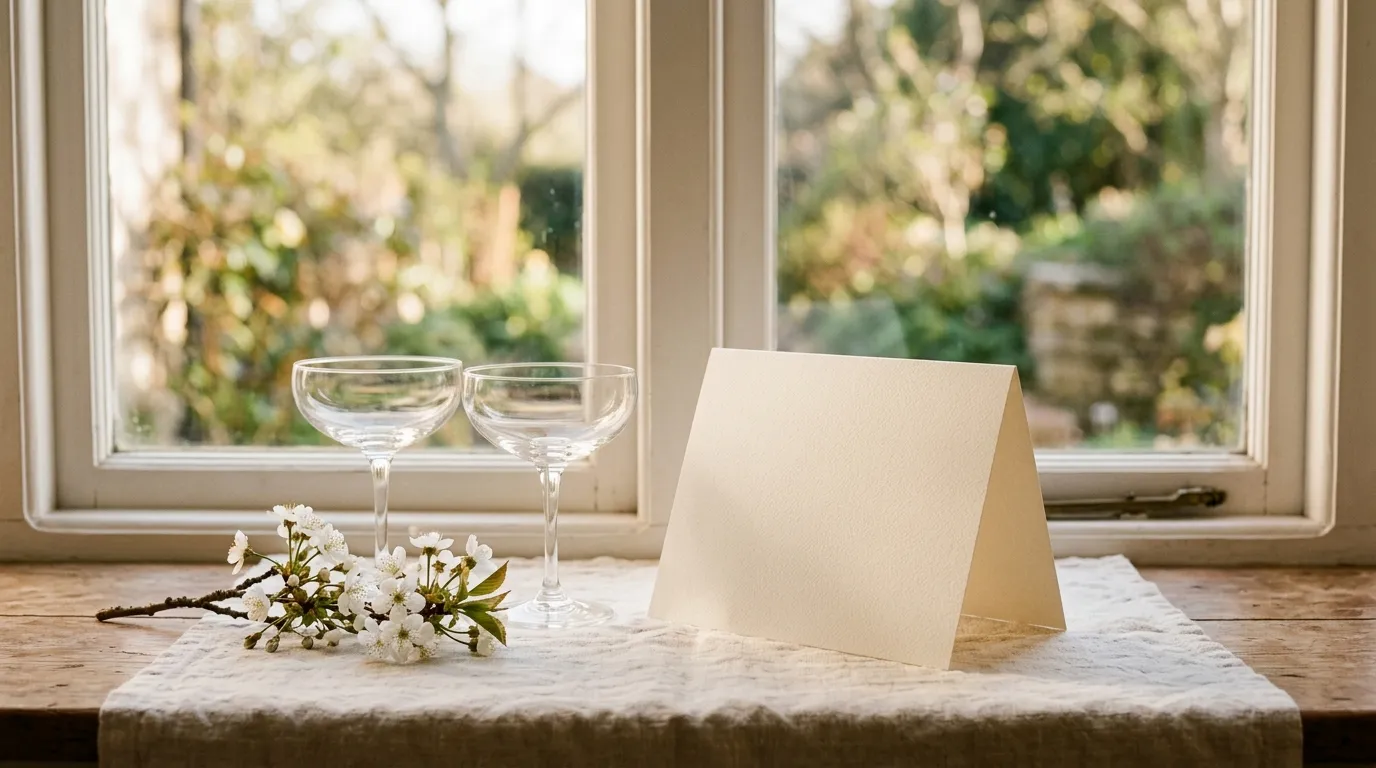
Congratulate them, keep it short, and mean it. An engagement card is the one piece of wedding-adjacent writing where brevity is genuinely better, and where almost everyone overthinks it.
For most guests the card is the gift: Debrett's states that engagement presents are not customary and that nobody should feel obliged to give one. So the card is carrying the whole occasion, which is worth two minutes of thought rather than thirty seconds of "Congratulations on your engagement!"
The shape that works
Three sentences, in this order, will serve almost every relationship you might have with the couple.
- The congratulation. Direct and warm. Say it once, properly, rather than three times in different words.
- Something specific to them. This is the only part that matters. One detail you actually know - how long they took, how obvious it was to everyone else, something one of them said.
- A forward look. Short. You are looking forward to the wedding, or to seeing them, or simply to what comes next.
That is the whole structure. The specific middle sentence is what separates a card that gets kept from one that goes in the recycling with the envelope.
What to actually write, by relationship
Close friend. You can be funny, because you have earned it. The safest funny is affectionate about how long it took or how unsurprising it was, never about the marriage lasting. "Finally." is a complete and excellent engagement card from the right person.
Family. Warmth beats wit. Say plainly that you are pleased, and say something about the person marrying in - welcoming them is the thing families forget to do in writing and remember for decades.
Colleague or acquaintance. Short and sincere. Do not reach for intimacy you do not have; a warm two-liner from a colleague reads much better than an attempt at in-jokes.
Someone you have reservations about. Congratulate the person you know, warmly and without qualification, and stop there. A card is not the venue.
What to leave out
A short list, all of it common and all of it landing badly.
- Marriage-is-hard jokes. "Last chance to run", "ball and chain", "rather you than me". Written down and kept in a drawer, these age very poorly.
- Wedding advice. They have been engaged for a fortnight. Nobody has asked yet.
- Questions. "Have you set a date?" is a conversation, not a card. It converts a keepsake into an admin request.
- Anything about children. Under any circumstances.
If you are announcing rather than congratulating
A different piece of writing, and one with actual conventions attached: the formal engagement announcement, still placed in local papers and in the national broadsheets. Debrett's sets out the forms, and they are worth having because guessing at them is obvious.
Traditionally the father of the bride organised this where her parents were hosting the wedding. It is now increasingly common for the couple to arrange it themselves.
A contemporary announcement runs:
Mr R Cooper and Miss K Fremantle
Mr Richard Cooper of Nant, Shropshire, and Miss Kate Fremantle of Drem, East Lothian, are delighted to announce their engagement.
A more traditional one names the parents:
The engagement is announced between Richard, elder son of Mr and Mrs John Cooper of Gask, Devon, and Kate, only daughter of Mr and Mrs Rufus Fremantle of Bayswater, London.
The form adapts rather than breaking. For a same-sex engagement: The engagement is announced between James, younger son of Mr Richard Simpson of Holt, Norfolk, and Piers, elder son of Mr and Mrs Michael Hardy of Ripponden, Yorkshire.
Where parents are divorced, each parent is named with their own address. Where a parent is widowed, the surviving parent is named. For a second marriage, the same structure holds with the appropriate titles.
The underlying logic is simply that everyone with a claim to be named gets named, and nobody is quietly written out of their own child's announcement. That is the part worth getting right; the rest is formatting.
Tell people in the right order
This is the etiquette failure that actually causes hurt, and it has nothing to do with wording.
Debrett's is firm: do not post anything about the engagement until immediate family and closest friends have been told - which, for the older generation, may mean a visit or a phone call rather than a message. There is no obligation to rush. A delay between getting engaged and telling the world is entirely yours to set.
Two smaller traps from the same guidance. Do not use the announcement to tag friends about being bridesmaids or ushers - building the wedding party is a person-to-person conversation. And if you are going to have a wedding hashtag, keep it out of the announcement, or you will be found by every planner, caterer and supplier with an alert set.
If you are the couple: the reply matters more than the card
One obligation in this area is stated firmly rather than suggested, and it falls on the couple.
Debrett's is explicit that any presents or offers of money should be gratefully acknowledged by letter after the event. Not a text. If parents have offered to contribute to the wedding, that is acknowledged the same way. It is the most-skipped rule in the whole engagement period and the one people remember.
Does the card need to be posted?
No, and handing it over at the party is normal. But if you cannot attend, post it rather than sending a message - the card is doing more work in that case, because it is standing in for you.
Worth reading next: who actually buys the engagement gift, which is a short answer.
The wider path: getting engaged, and then the wedding when the date is set.
Written by Craig Fearn, Printed Weddings.

Also in getting engaged
Questions
Questions, answered
What do you write in an engagement card?
+
Three sentences: a direct congratulation, one detail specific to the couple, and a short forward look. The specific middle sentence is the part that makes a card worth keeping. Keep the whole thing shorter than you think it should be.
Is a card enough for an engagement, or do you need a gift?
+
A card is enough. Debrett's states that engagement presents are not customary and nobody should feel obliged to give one, so for most guests the card is the whole gift - which is a reason to write it properly rather than a reason to buy something.
What should you not write in an engagement card?
+
Marriage-is-hard jokes, wedding advice nobody asked for, questions such as “have you set a date?”, and anything about children. The first ages badly in a drawer; the rest turn a keepsake into admin.
Should the couple reply to engagement cards and presents?
+
Presents and offers of money, yes - Debrett's says they should be gratefully acknowledged by letter after the event, which includes a parent's offer to contribute to the wedding. Cards alone do not require a written reply, though saying thank you in person is normal.