The UK wedding anniversary list: every year, material and name
Year one is paper and year fifty is gold. Between them the lists disagree with each other more than any gift shop admits. This is the British list as Debrett's gives it, what the competing "modern" list is and where it came from, and the two years that carry an actual rule rather than a custom.
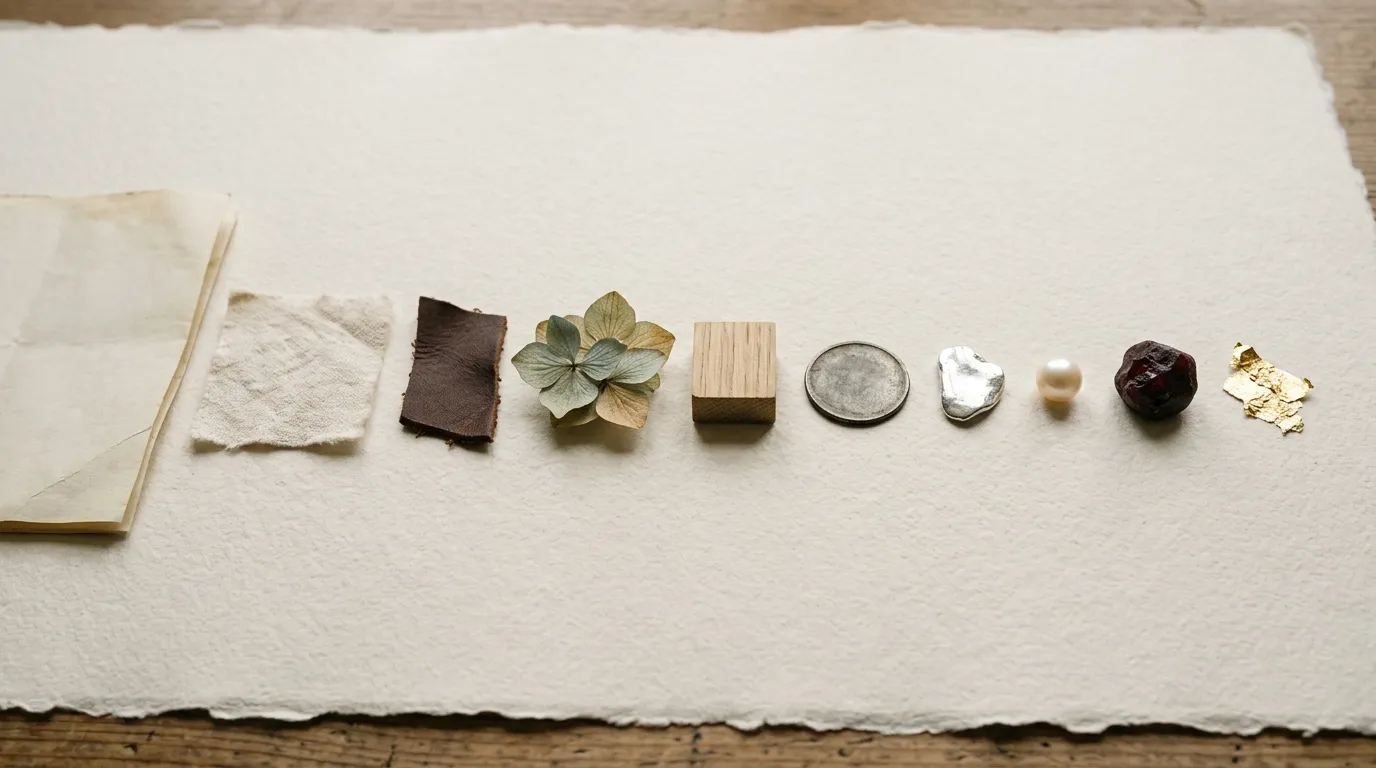
The short answer, for the year you came here for: 1 paper, 2 cotton, 3 leather, 4 flowers, 5 wood, 10 tin, 20 china, 25 silver, 30 pearl, 40 ruby, 50 gold, 60 diamond. The full run, including the awkward middle years nobody remembers, is below.
The longer answer is that there is no single official list, and anyone who tells you otherwise is selling something. There is a British convention, there is a competing American one, and there is a "modern" list that was written by a jewellers' trade body. They disagree at roughly a third of the years. Knowing which one you are reading matters more than getting the material exactly right.
The British list, year by year
This is the list as Debrett's publishes it, under the heading "British Wedding Anniversaries". Where a year carries two materials, both are given as alternatives rather than one superseding the other.
- 1st wedding anniversary. Paper
- 2nd wedding anniversary. Cotton
- 3rd wedding anniversary. Leather
- 4th wedding anniversary. Flowers or fruit
- 5th wedding anniversary. Wood
- 6th wedding anniversary. Sugar
- 7th wedding anniversary. Wool or copper
- 8th wedding anniversary. Bronze or pottery
- 9th wedding anniversary. Willow or pottery
- 10th wedding anniversary. Tin
- 11th wedding anniversary. Steel
- 12th wedding anniversary. Silk or linen
- 13th wedding anniversary. Lace
- 14th wedding anniversary. Ivory
- 15th wedding anniversary. Crystal
- 20th wedding anniversary. China
- 25th wedding anniversary. Silver - the silver wedding
- 30th wedding anniversary. Pearl - the pearl wedding
- 35th wedding anniversary. Coral
- 40th wedding anniversary. Ruby - the ruby wedding
- 45th wedding anniversary. Sapphire
- 50th wedding anniversary. Gold - the golden wedding
- 55th wedding anniversary. Emerald
- 60th wedding anniversary. Diamond - the diamond wedding
- 70th wedding anniversary. Platinum - the platinum wedding
Two things to notice, because most published lists quietly paper over both. After year fifteen the British list stops running every year and jumps in fives. And Debrett's gives no material at all for the 65th, even though the 65th is one of only three named anniversaries that qualifies for a message from the King. The list and the honours system do not line up, and nobody has ever tidied that.
What each milestone is called
The list is really two lists in one. Every year has a material, and a handful of years also have a name - which is what most people are actually reaching for when they ask what a particular anniversary is.
- The silver wedding is the 25th wedding anniversary.
- The pearl wedding is the 30th wedding anniversary.
- The ruby wedding is the 40th wedding anniversary.
- The golden wedding is the 50th wedding anniversary.
- The diamond wedding is the 60th wedding anniversary - 60 years of marriage. This is the phrasing royal.uk itself uses, "their diamond wedding (60th)".
- The platinum wedding is the 70th wedding anniversary.
The years in between carry a material but no name in ordinary use. Nobody says "the tin wedding" for a 10th wedding anniversary or "the china wedding" for a 20th, even though tin and china are the materials. If you have seen a name for one of those years, it has almost certainly been coined by a greetings-card publisher rather than inherited.
The naming also explains the shape of the tradition. The named years are the old ones - the 25th and 50th were being marked in the Middle Ages, long before anything was attached to a 9th or an 11th. A year has a name because people were already celebrating it; a year has only a material because a list was later extended over it.
Why the list you were sent does not match this one
Three different lists are in circulation in Britain, and they are usually reproduced without saying which is which.
The traditional British list is the one above: paper, cotton, leather, running up through the materials in rough order of durability. The logic is legible - a marriage is supposed to get sturdier, so the gifts start flimsy and end in stone and metal. It is old, it is vague at the edges, and it is the one Debrett's recognises.
The traditional American list mostly agrees for the famous years and diverges in the middle. If a list you have been given carries an unfamiliar material in a single-digit year, an American source is the usual reason.
The modern list is a different animal altogether, and the next section is about where it came from.
The "modern" list is a jewellers' trade list
The modern list is a jewellers' trade product, dated to 1937 and credited to what is now Jewelers of America - an attribution that is well supported but not proven, since it survives through a 2001 book rather than a 1937 document. where the modern list came from traces it in full. You will also see the list credited to the Chicago Public Library; that version circulates widely on gift sites but does not hold up, and the library publishes no such list.
What is not in doubt is the shape of the thing. The traditional list ran thin after fifteen years and then jumped in fives. The modern list fills in every year and adds materials that could actually be sold in a shop: clocks at one, china at two, appliances, watches, desk sets. A trade association filling every year of a marriage with a purchasable object is not a neutral act of record-keeping. It is a merchandising calendar, and it is why year one is a clock.
None of which makes it wrong to use. It does mean that when a gift guide tells you the "modern" gift for your year is a piece of jewellery, you are reading a jewellers' recommendation, and you are allowed to ignore it.
The 14th is ivory, and you cannot legally buy it
This is the one year where following the list will get you into genuine trouble.
The traditional fourteenth-anniversary material is ivory. Dealing in ivory in the UK is banned. The Ivory Act 2018 came into force for elephant ivory on 6 June 2022 and was extended to hippopotamus, killer whale, narwhal and sperm whale on 28 January 2025. It prohibits dealing in items made of or containing ivory from any of the five. There are narrow exemptions - certain pre-1947 items with a very low ivory content, pre-1918 portrait miniatures, some pre-1975 musical instruments, sales between qualifying museums - all of which require registration or a certificate. Dealing outside them carries a maximum fine of £250,000 or up to five years' imprisonment.
So treat ivory at fourteen as a colour and a texture rather than a material: cream, bone, ivory-coloured paper, ivory silk, ivory-glazed ceramic. That is what almost everyone marking a fourteenth actually does, whether or not they know why.
The years that carry a rule rather than a custom
Almost all of this is convention, and you can disregard any of it. Two things are not convention.
The message from the King. Milestone anniversaries can be marked with a message from His Majesty, but only some of them. GOV.UK restricts it to the sixtieth, the sixty-fifth, the seventieth and "each year following their 70th". The golden wedding at fifty does not qualify. It has to be applied for, and the deadlines, the marriage certificate you have to send and the free-of-charge position are all set out on GOV.UK's page on anniversary messages from the King.
Which years get a party. Not a rule exactly, but a strong and consistent one in Britain: the 25th and the 50th are the two that reliably get an event, and the 60th increasingly does because of the Royal message attached to it. Debrett's notes that in the Middle Ages only the 25th and 50th were commonly marked at all; everything between them is a Victorian and twentieth-century addition.
What Debrett's actually says about following it
Worth quoting, because it is the opposite of how anniversary lists are usually sold. Debrett's describes the list as "merely a suggestion, not a prescriptive set of instructions".
That is the correct posture. The list is useful in exactly one way: it removes the blank page. If you know the year is tin, you have somewhere to start and a constraint to be inventive inside. If tin produces nothing anyone would want, the list has done its job by being ignored.
The gap years, and what to do with them
The British list runs every year to fifteen, then gives you twenty, twenty-five, thirty, thirty-five, forty, forty-five, fifty, fifty-five, sixty and seventy. Which leaves sixteen, seventeen, eighteen, nineteen, twenty-one through twenty-four, and every year in the fives gaps with nothing attached to them at all.
Filled-in versions of those years do exist, and they come from modern and American lists rather than the British one. That is not a reason to avoid them, but it is worth knowing that a "wax" eighteenth or a "brass" twenty-third has no British pedigree behind it - it was written to fill a hole in a retail calendar.
The two honest options for a gap year are to borrow the modern list and say so, or to ignore materials entirely and mark the year on its own terms. Nobody celebrating a seventeenth is expecting furniture.
Anniversary flowers and colours are a separate, weaker tradition
You will find charts assigning a flower and a colour to every anniversary year. Treat these differently from the materials, because they do not have the same standing.
Debrett's British list gives materials only. It assigns no flowers and no colours at any year, and the one place a flower appears is at the fourth anniversary, where "flowers or fruit" is itself the material. Beyond that, the flower and colour charts come from florists and greetings-card publishers rather than from any etiquette authority, and they vary between sources: the same year is given different flowers by different sellers, and some years have no agreed flower at all.
So a flower chart is a perfectly good prompt if you want one, and a bad thing to correct anybody with. If someone tells you the flower for your year is wrong, there is no book to look it up in.
Choosing something for the year you are at
The materials get easier to buy as the years go up, which is backwards. Paper, cotton and tin are hard; silver, ruby and gold buy themselves. The list is least useful exactly where it is hardest to shop.
- The first years - paper, cotton and wood, where the list asks the most of you.
- The milestones - tin, silver, pearl, ruby and gold, and what earns a place on a wall.
- What to actually give for each year - this page is the list; that one is the ideas.
- What the symbols are supposed to mean - the reasoning behind the materials, where there is any.
Written by Craig Fearn, Printed Weddings.
Also in the first years
Try it
Upload one photo and see the two of them in every style we paint. Free, watermarked, no sign-up, about twenty seconds.
Questions
Questions, answered
Is there an official UK wedding anniversary list?
+
No. There is no official or statutory list. Debrett's publishes the most widely recognised British version, which is the one set out on this page, and describes it as "merely a suggestion, not a prescriptive set of instructions". Competing traditional American and modern lists circulate alongside it and disagree at roughly a third of the years.
What is the difference between the traditional and modern anniversary lists?
+
The traditional list runs paper, cotton, leather, wood and so on, thinning out after fifteen years and then jumping in fives. The modern list fills in every year and substitutes purchasable goods - clocks at one, china at two. The modern list is usually dated to 1937 and credited to the American National Retail Jeweler Association, a trade body, which is worth bearing in mind when it recommends jewellery.
Which wedding anniversaries get a card from the King?
+
Cards are sent for the diamond wedding (60th), the 65th, the 70th and every year thereafter. The 50th does not qualify, which surprises most people. How to apply, the deadlines and what it costs are set out on our diamond wedding page.
Can you still buy ivory for a 14th anniversary in the UK?
+
No, other than under narrow exemptions. The Ivory Act 2018 came into force for elephant ivory on 6 June 2022 and was extended to hippopotamus, killer whale, narwhal and sperm whale on 28 January 2025, with limited registered or certificated exemptions for certain pre-1947 and pre-1918 items and some pre-1975 musical instruments. Penalties reach a £250,000 fine or five years' imprisonment. In practice the fourteenth is marked with ivory as a colour - cream, bone, ivory silk or paper.
What is 60 years of marriage called?
+
The diamond wedding. royal.uk uses exactly that phrasing - "their diamond wedding (60th)" - and it is one of only three wedding anniversaries that qualifies for a message from the King, along with the 65th and the 70th. The material for the 60th on the British list is diamond.
Why is there no material for the 65th anniversary?
+
Debrett's British list gives no material for the 65th, jumping from the 60th (diamond) to the 70th (platinum). It is one of the list's genuine gaps, and an odd one, because the 65th is one of only three named anniversaries that qualifies for a message from the King. Where you see a 65th material quoted it usually comes from a modern or American list rather than the British convention.