What is the silver wedding anniversary?
The silver wedding anniversary is the 25th year of marriage: the traditional milestone symbol is silver.
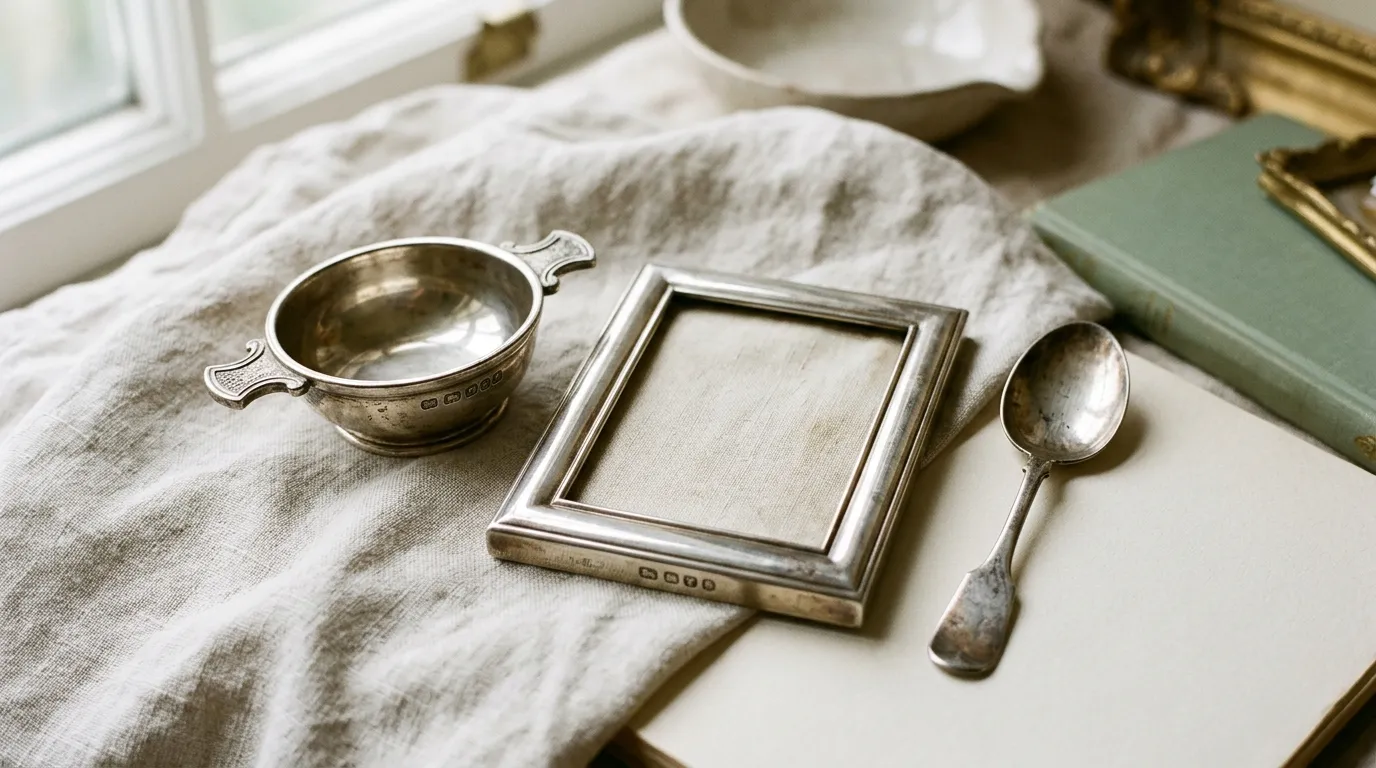
The silver wedding anniversary is 25 years of marriage. Silver is the material the British list gives for year 25.
That is the whole answer. The rest of this page is the part nobody explains: what silver actually is when you buy it in Britain, how to read the marks stamped on it, and the one gift those marks make possible that no shop will ever suggest to you.
Why the 25th is one of the two oldest anniversaries
Most anniversary years are recent inventions. The 25th is not.
Debrett's describes medieval couples marking the 25th and the 50th with silver and gold wreaths, and calls those comparatively rare events. Everything between them was added later - during the Victorian era and then through the twentieth century, as the list was extended year by year and, eventually, merchandised. The modern list that fills in every single year is usually dated to 1937 and credited to a jewellers' trade association, which tells you what it was for.
So the silver wedding is one of only two anniversaries with an unbroken history behind it. That is roughly why it still feels different from a 23rd, and why it is usually the first anniversary a couple marks with a proper party rather than a dinner.
What a UK hallmark actually guarantees
If the gift is real silver rather than silver-toned, the hallmark is the part worth understanding, and almost nobody explains it.
Selling articles of precious metal in Britain is controlled by the Hallmarking Act 1973. It is a criminal offence to describe an article as silver if that description is not true. An approved hallmark is one applied by a UK Assay Office - there are four, in London, Birmingham, Sheffield and Edinburgh.
The Goldsmiths' Company Assay Office in London sets out what a hallmark actually does. It means the article has been independently tested. It guarantees the piece conforms to legal standards of purity. And it guarantees provenance: where the piece was marked, what it is made from, and who submitted it.
That is a genuinely unusual thing to exist. Almost nothing else you can buy carries an independent, legally enforced guarantee of what it is made of.
The five marks, and what each one tells you
A full traditional UK hallmark is made up of five component marks. Three are compulsory and two are optional.
- The sponsor's mark - compulsory. Two to five initials inside a shield, unique to the person or company that submitted the piece. It is often called a maker's mark, but the Assay Office is explicit that its purpose is to establish responsibility rather than to identify who physically made the item.
- The millesimal fineness mark - compulsory. A number giving the precious metal content in parts per thousand. This numerical format was only made compulsory in 1999. A piece is marked to the lowest standard it contains, so the number guarantees the whole article is no less pure than stated.
- The Assay Office mark - compulsory. Which of the four offices tested it. London's is the leopard's head.
- The traditional fineness symbol - optional. The pictorial mark, such as the lion passant for sterling silver.
- The date letter - optional. The year it was hallmarked. More on this below, because it is the interesting one.
Sterling, Britannia, and what 925 means
The fineness number is the one people half-recognise. For silver, the standards recognised under the international Hallmarking Convention are 800, 925 and 999.
925 is sterling silver - 925 parts silver per thousand, the everyday British standard. 999 is fine silver, softer and less common in objects meant to be used. Britannia silver, at 958, carries its own traditional symbol and sits above sterling.
One thing to know before you shop. Small items are exempt from hallmarking altogether: an article is exempt if it contains less than 7.78 g of silver. Below that weight, a "925" stamp is the maker's own claim rather than an Assay Office's independent test. That is not necessarily a problem - a great deal of light, honest silver is sold this way - but it is the difference between a declaration and a verification, and it is worth knowing which one you are paying for.
The date letter, and the gift nobody suggests
The date letter changes annually on 1 January. The font, the case and the shape of the surrounding shield all change together, so any given letter can only indicate one specific year - and every date punch is destroyed at the end of the year it belongs to. A hallmarked piece can therefore be dated exactly, from the metal itself, forever.
Which opens up a silver-wedding gift that no shop will offer you: find a piece of hallmarked silver whose date letter is the year they married. A spoon, a small frame, a christening mug, a napkin ring. It is twenty-five years old, the same age as the marriage, and it is the only silver gift that is specific to the two of them rather than to the occasion.
Any of the four Assay Offices publish date letter charts, and a reputable antique silver dealer will read the marks for you in a minute.
Commemorative marks, if the year is a lucky one
Occasionally the hallmark carries something extra. Commemorative marks have been added to the standard hallmark to mark national events, and the Assay Office lists them: the 1935 Silver Jubilee, the 1953 Coronation, the 1977 Silver Jubilee, the 2000 Millennium mark, the 2002 Golden Jubilee and the 2012 Diamond Jubilee.
If the couple married in one of those years, a piece hallmarked that year may carry the commemorative mark alongside the date letter. It is a small thing and entirely a matter of luck, but it turns a dated object into a dated object with a story.
Buying silver from abroad, and the post-Brexit trap
If you are buying online from a European seller, this catches people out.
The UK belongs to the international Hallmarking Convention, and a Convention hallmark carrying the Common Control Mark is accepted here without needing to be re-assayed. Hallmarks from European Economic Area countries are also accepted - but only if they were applied before the end of the post-Brexit transition period on 31 December 2020. The UK no longer accepts new items from European countries that are not Convention members.
Two further things void a hallmark. An article is treated as unhallmarked if it lacks the approved marks and a sponsor's mark - and, less obviously, a hallmarked article is treated as unhallmarked if it has been the subject of an improper repair. Worth knowing before you have a piece of antique silver resized or mended.
One last consumer signal: any dealer in precious metals must display a Hallmarking Act 1973 dealers' notice on the premises, in a conspicuous position. If you are in a shop and cannot see one, that tells you something.
Does the 25th get a message from the King?
No, and it surprises people, because a silver wedding feels like exactly the sort of milestone that would qualify. It is thirty-five years short: the threshold is the diamond wedding at 60. How to apply, and the deadlines that catch people out.
What people actually give
Real silver is the obvious route - a hallmarked frame, a quaich, cutlery, a piece of jewellery - and plenty of couples go silver-toned instead, which nobody minds. The material is a prompt, not an instruction.
The one thing worth avoiding is anything engraved "25 years" and nothing else. Twenty-five years is the occasion; the couple is the subject. A gift that only records the number will be looked at once.
Every other year: the UK anniversary list from the 1st to the 70th. For ideas and budgets see our 25th anniversary gift guide; the golden wedding is the 50th and the pearl wedding is the 30th.
Hallmarking detail from the Goldsmiths' Company Assay Office and from Business Companion, the government-backed Trading Standards guidance (reviewed July 2025).
Written by Craig Fearn, Printed Weddings.
Also in the milestones
Try it
Upload one photo and see the two of them in every style we paint. Free, watermarked, no sign-up, about twenty seconds.
Questions
Questions, answered
How many years is a silver wedding anniversary?
+
Twenty-five years of marriage, and silver is what the British list gives for that year.
Does silver have to be hallmarked in the UK?
+
Above a weight threshold, yes. Under the Hallmarking Act 1973 it is a criminal offence to describe an article as silver untruthfully, and an approved hallmark must be applied by a UK Assay Office - London, Birmingham, Sheffield or Edinburgh. Articles containing less than 7.78 g of silver are exempt, so on a very light piece a "925" stamp is the maker's own claim rather than an independent test.
What does 925 mean on silver?
+
925 parts silver per thousand - sterling silver, the standard British quality. It is the millesimal fineness mark, a compulsory part of a UK hallmark since the numerical format was made compulsory in 1999. The silver finenesses recognised under the international Hallmarking Convention are 800, 925 and 999.
Can you tell what year a piece of silver was made?
+
Often, yes, and exactly. Alongside the compulsory marks a piece may carry an optional date letter, which changes every 1 January. The font, case and shield shape all change together so each letter indicates one specific year, and the punches are destroyed at the end of that year. It makes a genuinely specific silver-wedding gift possible: a hallmarked piece dated to the year the couple married.
Are European hallmarks accepted in the UK?
+
Only in limited circumstances. Convention hallmarks carrying the Common Control Mark are accepted, as the UK is a member of the international Hallmarking Convention. Hallmarks from European Economic Area countries are accepted only if they were applied before the end of the post-Brexit transition period on 31 December 2020; the UK no longer accepts new items from European countries outside the Convention.
Do you get a card from the King for a silver wedding?
+
No. The silver wedding is thirty-five years short of the threshold, which is the diamond wedding at 60. The golden wedding at 50 does not qualify either, which is the part that catches most families out.