Guide · Writing wedding vows
How to write
wedding vows.
The structure that works in almost any ceremony, why it works, what most couples get wrong, and how to keep the words safely after the day.
The structure that works
Personalised vows are a recent freedom. What opened the door was the Marriage Act 1994, which from 1995 let couples marry on approved premises — hotels, country houses, the venue where the reception happens — rather than only in a register office. Civil ceremonies have since become the norm: of the 246,897 marriages in England and Wales in 2022, the ONS recorded 83% as civil, not religious. Three decades of those ceremonies have settled on a five-part structure that holds up across humanist, registry, religious, and elopement formats:
- № 01Declaration~15 words
- № 02Why I love you~30 words
- № 03Promises~45 words
- № 04The future~20 words
- № 05Closing line~10 words
Total length: about 120 words, or 60–90 seconds spoken. Long enough to carry weight; short enough to keep the room with you.
№ 01 Open with a declaration
One sentence that names the moment. The traditional opening is the legal declaration the registrar reads — the words section 44 of the Marriage Act 1949 requires ("I do solemnly declare…") — and the personal opening that follows is one line of your own. Example:
"I, James, take you, Sarah, to be my wife, from today and for every day after."
The job of this line is to anchor everyone in the room. They know you're going to say it; saying it well is the formal start. Don't try to be clever here — clarity beats wordplay.
№ 02 Say why you love them
Two or three specific reasons. Specific is the entire game here. "You make me laugh" tells the room nothing. "You laugh at your own jokes before the punchline lands, and I'm always there for the punchline" tells the room a marriage. Example:
"I love the way you sing along to songs you don't know the words to. I love that you call your mum every Sunday. I love that you've never once made me feel small for not knowing something."
Three reasons is the right count — fewer feels thin, more feels like a list. Lean into ordinary moments. Wedding guests don't want to hear about grand gestures; they want to hear about coffee in the morning.
№ 03 Make three concrete promises
This is the heart of the vow. Promises are concrete actions, not abstract feelings. "I promise to love you always" is a feeling. "I promise to make us tea when one of us is too tired to ask for it" is a promise.
"I promise to keep choosing you, even on the days when you've left wet towels on the bed. I promise to be the calm one when you can't be, and to let you be the calm one when I can't. I promise to always tell you when something is wrong, before it becomes something we can't talk about."
The "I promise to / I promise to / I promise to" cadence is doing real work. It signals to the room that this is the centre of the vow, and gives you a structure to write into. Aim for three. Two feels under-baked, four loses momentum.
№ 04 Acknowledge the future
One short sentence that names the unknowns. This is the most honest part of any vow and the most often skipped. Example:
"I don't know what the next fifty years will bring, but I know I want to face it with you."
The future-acknowledging line is the one your guests will remember a year later when something hard happens to one of you. It earns its place.
№ 05 Close with one strong line
A single closing sentence that summarises the whole thing. This is the line that should be the last thing the room hears before you stop talking — and it's the line that ends up on the framed vow print. Example:
"I am yours, and you are mine, and I will spend the rest of my life proving I was paying attention."
Keep this line short. Aim for under 20 words. It needs to be deliverable without faltering and rememberable without effort.
What most couples get wrong
- Inside jokes that exclude the room. Funny once, awkward forever.
- Reciting song lyrics or poetry as the vow. Quote a line if you want; don't outsource the whole thing.
- Writing them the night before. Start six weeks out, do two drafts, leave it alone for a week, then revise.
- Reading them dramatically. Read like you're talking to one person — the person you're marrying. The room will lean in.
- Comparing length with your partner. Settle on a rough target together. The shorter set always lands as well as the longer one.
Keeping them after the day
Once you've said your vows, the temptation is to fold the paper into the wedding album and not see it again for ten years. The vows are the most important sentences either of you will write — they deserve somewhere visible.
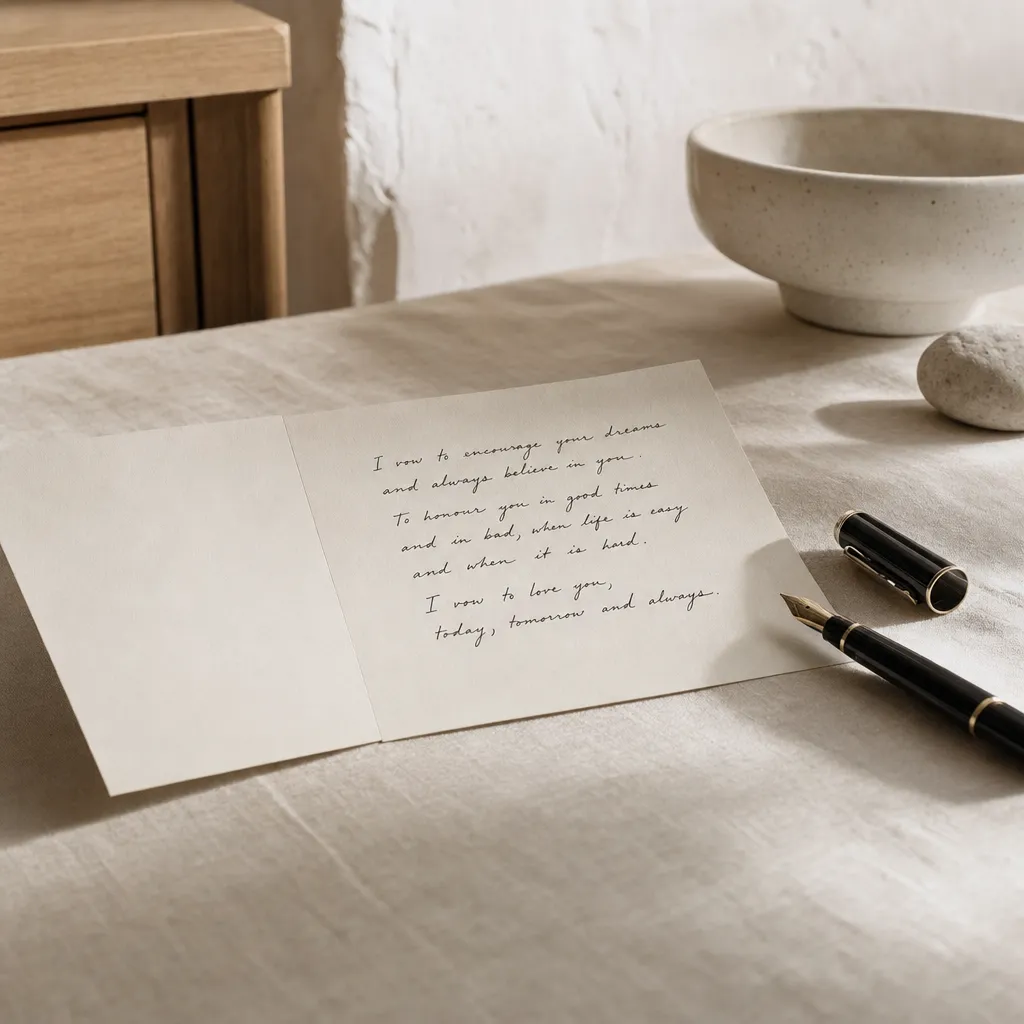
Keep the words somewhere you'll actually see them. Copy the final version into a notebook you'll keep, or frame the handwritten card you read from on the day — the creases and the nervous handwriting are half the point. And if you want something on the wall that marks the marriage itself, our couple portrait turns a photo of the two of you into a framed piece you preview before you pay.
Frequently asked
How long should wedding vows be?
60 to 90 seconds spoken, which is roughly 100–150 words. That works out to four to six short paragraphs. Longer than that and the room loses focus; shorter than that and they feel under-cooked. Aim for around 120 words.
Can I read my vows or do I need to memorise them?
Read them — every officiant and every wedding photographer will tell you the same thing. Holding a small card or a notebook is fine and looks dignified. Memorising adds nerves and risks freezing; nobody expects a TED talk.
Should both of you write your own vows, or share one set?
Most couples writing their own vows write them separately and don't see each other's until the ceremony. That preserves the surprise and the emotional weight. If you want them to mirror each other (similar length, same structure), agree the structure together but write the content alone.
Is it OK to use a mix of traditional and personal vows?
Yes, and many UK ceremonies do exactly this — the traditional declaration ("I do solemnly declare that I know not of any lawful impediment…") followed by a personalised exchange of vows. Check with your registrar or officiant on the legal-language portion; the personalised section is yours.
Can I be funny in my wedding vows?
Humour works in small doses — one or two warm, knowing lines. Avoid full standup routines, inside jokes that exclude the room, or anything that punches down. The job of vows is connection, not entertainment.
What if I cry while saying them?
Almost everyone does. Pause. Breathe. The room is on your side. Bring a cotton handkerchief (it's the second-anniversary material — you might as well start the symbolism early).